Kota Ezawa, born in 1969 in Cologne, Germany, is a German-Japanese-American artist living and working in Oakland, California, whose practice spans video animation, light boxes, watercolours, murals, sculptures, and paper cutouts. Mining imagery from news media, art history, photography, film, and popular culture, Ezawa translates recognisable depictions of contemporary and historic moments into a distinctive graphic style that straddles abstraction and representation. By converting source material into geometric shapes, unmodulated colours, and flattened compositions that evoke both colour field painting and cartoon animation, he purposefully reduces visual detail so that the resulting images are read more intuitively than their real-world counterparts. What remains when an image is stripped to its essentials is not simplification but clarification: a mirror held up to the symbolic power of the original, inviting the viewer to contend with its personal, cultural, and historical weight anew. Ezawa has participated in the Whitney Biennial and the Shanghai Biennale, and his work is held in the collections of the Museum of Modern Art, the Metropolitan Museum of Art, the Whitney Museum of American Art, the Art Institute of Chicago, the Hirshhorn Museum and Sculpture Garden, the San Francisco Museum of Modern Art, and the J. Paul Getty Museum, among others. He is a recipient of a Guggenheim Fellowship, a Louis Comfort Tiffany Foundation Award, a SECA Art Award, and a Eureka Fellowship. KORNFELD Galerie Berlin presented Kota Ezawa in the solo exhibition OPUS III at 68projects in 2021, and at ARCO Madrid and LOOP Barcelona.
-

-
Kabul, 2021 Sold
-


Kota Ezawa was born in 1969 in Cologne, Germany, and lives and works in Oakland, California. He studied at the Kunstakademie Düsseldorf and the San Francisco Art Institute before receiving his MFA from Stanford University. His practice has since developed into one of the most conceptually distinctive bodies of work in contemporary art, operating at the intersection of image culture, historical memory, and the politics of representation.
Ezawa's method begins with a close and deliberate act of translation. Taking source imagery from news footage, film, art history, and popular culture, he redraws it by hand in a graphic style that converts recognisable scenes into geometric forms, flat unmodulated colour, and simplified compositions. The resulting works, whether video animations, light boxes, watercolours, or sculptures, sit in a visual register that recalls both colour field painting and cartoon animation. Described by the artist himself as "animated paintings", they combine a handmade aesthetic with an image language borrowed from comics and pop art. By reducing complex visual information to its fundamental elements, Ezawa does not diminish his source material but intensifies it: the viewer, confronted with a familiar event or image in an unfamiliar form, is invited to reckon with its symbolic weight, its cultural resonance, and their own relationship to it. His works act as a mirror, reflecting back the power of the images that shape collective consciousness.
This approach has produced works of remarkable range and ambition. His long-running OPUS project, a three-part exhibition series with stops in New York, Frankfurt, and Berlin, brought together video projections, watercolours, light boxes, and spatial installations reflecting on isolation, separation, war, and peace. THERISEANDFALLOFTHEBERLINWALL (2021), a video projection onto a wall of concrete blocks, drew on archival newsreel footage to trace the arc from the wall's construction in 1961 to its fall in 1989. Ezawa has also produced major site-specific public artworks for the University of California San Francisco, Madison Square Park in New York, San Francisco International Airport, and the Vancouver Art Gallery Offsite.
His institutional exhibition history is extensive. Solo presentations have taken place at the Baltimore Museum of Art, the Museum of Contemporary Art Santa Barbara, SITE Santa Fe, the Mead Art Museum, the Chrysler Museum of Art, the Buffalo AKG Art Museum, the Yerba Buena Center for the Arts in San Francisco, the Vancouver Art Gallery, and the Wexner Center for the Arts in Columbus, Ohio. Group exhibitions include Out of the Ordinary at the Hirshhorn Museum and Sculpture Garden, After Photoshop at the Metropolitan Museum of Art, Screen Play: Life in an Animated World at the Buffalo AKG Art Museum, and Last Year in Marienbad: A Film as Art at the Kunsthalle Bremen. He participated in the Whitney Biennial in 2019 and the Shanghai Biennale in 2004. His work is held in the permanent collections of the Museum of Modern Art, the Metropolitan Museum of Art, the Whitney Museum of American Art, the Art Institute of Chicago, the Hirshhorn Museum and Sculpture Garden, the San Francisco Museum of Modern Art, the Smithsonian American Art Museum, the J. Paul Getty Museum, the Musée d'art contemporain in Montréal, and the National Gallery of Victoria in Australia, among others.
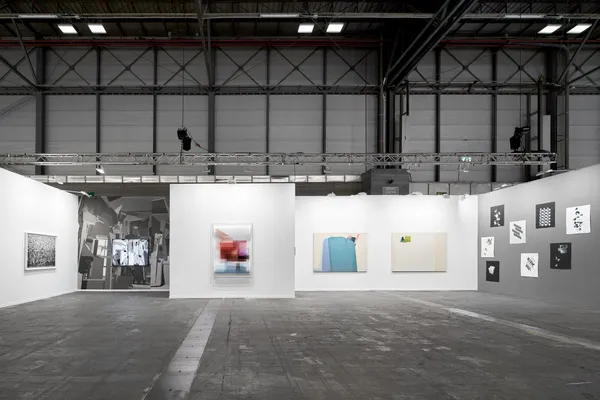
KORNFELD Galerie Berlin presented Kota Ezawa in the solo exhibition OPUS III at 68projects, Berlin, in 2021, the final chapter of a three-part project that used the history of the Berlin Wall as a lens through which to examine borders, division, and the universal human cost of separation. The gallery has also presented his work at ARCO Madrid and LOOP Barcelona.
-
Artforum
Kota Ezawa -
artsy
Kota Ezawa's Flat, Stylised Paintings and Animations Shed New Light on Historic EventsJanuary 18, 2022 -
Art at Berlin
Kota Ezawa | OPUS III | 68 projectsOctober 29, 2021 -
LUM Art Magazine
Kota Ezawa: The Crime of Art, InterviewFebruary 3, 2019 -
Southwest Contemporary
Kota Ezawa: The Crime of ArtNovember 1, 2017