Trust Issues – Groupshow

A secret sadness lurks behind the twenty-first-century’s forced smile.
— Mark Fisher
Our times put trust in both physical and mental freedom to the test. Fake news has turned truth into a precious resource, raising the urgent question: Can we unquestioningly trust algorithms, templates, or AI-generated content? How do we recognize pre-programmed distortions and resist their influence?
Saelia Aparicio, a London-based multidisciplinary artist, Gonzalo García, a painter living in Mexico, and Rusudan Khizanishvili, based in Tbilisi, explore themes of vulnerability, trust, and power in their works—each with a distinct visual language.
The exhibition is curated by Nina Chkareuli-Mdivani, a Georgian curator based in New York, who focuses on contemporary art and social issues.



The time we live in makes trust in physical freedom and freedom of thought essential; the proliferation of fake news has turned trust into a precious commodity. Can we fully believe algorithms, templates, ChatGPT interactions, prejudices, and preconceptions? How might we stop being vulnerable to pre-programmed biases and refrain from willingly consuming them?
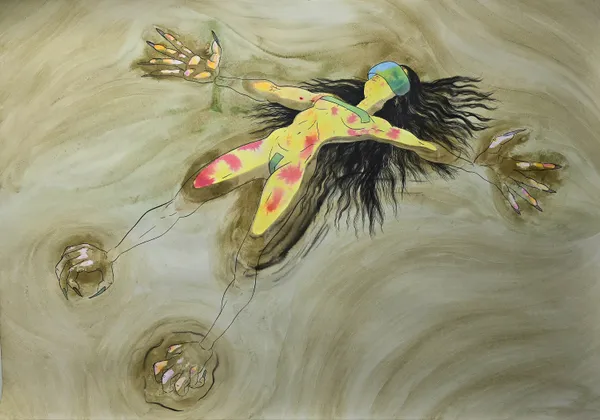
London-based multidisciplinary artist Saelia Aparicio, Mexico-based painter Gonzalo Garcia, and Tbilisi-based painter Rusudan Khizanishvili engage with issues of vulnerability, trust, and power while foregrounding their distinct visual languages. Aparicio’s anthropomorphic wooden sculptures, Garcia’s oil paintings on linen—simultaneously gentle and brutal—and Khizanishvili’s bold, symbolic use of color enter into a visual dialogue. The three transgressive artists seek to awaken viewers through strong visual statements that are at times intentionally ambiguous or ironic, and at other times grounded in specific political events such as the anti-government protests in Georgia in 2024–2025 or the student protests in Mexico in the 1960s.
In her new oil paintings, Rusudan Khizanishvili plays with words and symbols. Created during the first political protests in Georgia in spring 2024, these works reflect on protective and political coverings as means of societal control. Theatrical red veils are part of the “behind-the-scenes” mechanisms that Khizanishvili has explored throughout her career. Some of these mechanisms can be traced back to Persian miniatures, others to mythological representations of guardian figures. Her characters are abstracted from individual traits when depicting human or social dramas; they may appear pagan or neo-human, with indirect references to the novels of Michel Houellebecq, yet at their core lie our souls and their pursuit of harmony.
Gonzalo Garcia’s figurative oil paintings approach trust, power, and violence in a more literal and deliberately transgressive, confrontational manner, designed to provoke feelings of unreality and disbelief. Scenes of castration and potential physical or psychological torture unfold dynamically before the viewer. Inspired by Mexican cinema of the 1970s and films such as El Castillo de la Pureza by Arturo Ripstein and Los Cachorros by Jorge Fons, Garcia is interested in constructing a hybrid history of an authoritarian utopia that insists on gender correction. The faces of neither torturers nor victims are shown, allowing viewers to project identities and details themselves. Lyrical still lifes referencing the artist’s earlier explorations of queer identity—abstractly evoking marketplaces and childhood spaces in Mexico City—offer gentler images of transformation, surrender, and the freedom to exist.
Saelia Aparicio adopts an experimental approach to investigate where we stand as physical bodies in this era of capitalist realism, as defined by philosopher Mark Fisher, with whom the artist feels a close affinity. Her anthropomorphic stools and drawings engage with human, gender-fluid bodies that are deliberately vulnerable and playful. Referencing folklore, popular culture, and feminism, as well as the materiality of wood, glass, fabric, and clay, Aparicio asks how we can remain human and open in the face of oppressive forces. Her response is one of hope, risk, humor, and experimentation: between rigid classifications and dualities lie fissures where space for the unknown can emerge—spaces for mutant creatures that open windows to the unexpected, rather than confining us to prescriptions imposed by digital structures or doom-laden narratives.
All three artists employ distinct formal strategies to examine varying degrees of trust and to question how we, as a human species, might survive this era of uncertainty. It seems that only humor, harmony, risk, and art can help us resolve our trust issues.
— Nina Chkareuli-Mdivani

