Hubert Scheibl & David Meshki – Paintings, Photographs

Within the works of both artists the viewer is entering into a representation of reality in which boundaries of time are blurred and the subjects of the works are roaming free within indefinable spaces. For both Scheibl and Meskhi, the subject matter is often frozen between action and reaction, ignorant for that moment of its movement through the passage of time, providing an evocative melding of past and present and a sense of the fragility of memory. Movement plays a central role as Meskhi's subjects are swimming in space and Scheibl's brushstrokes create deliberate gestural-abstractions of motion.


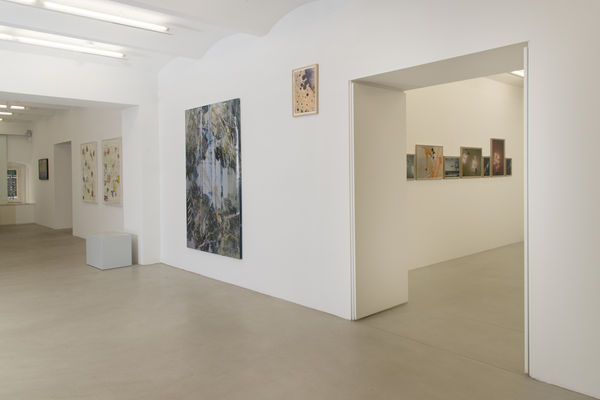
Galerie Kornfeld is pleased to present a duo exhibition featuring abstract oil paintings by Austrian artist Hubert Scheiblalongside photographs by Berlin-based Georgian artist David Meskhi for Berlin Art Week.
Within the works of both artists, the viewer enters a representation of reality in which boundaries of time are blurred and the subjects roam freely within indefinable spaces. Temporal concepts of beginnings and ends dissolve as the layers of Scheibl’s paintings give room to actions of past and present within the fabric of the paint itself and the hand of the artist at play. Similarly, images of gymnasts floating impossibly in Soviet gymnasiums within Meskhi’s photographs could have been taken generations earlier; however, the ephemerality of his subject matter disrupts the context of time altogether.
For both Scheibl and Meskhi, subject matter is often frozen between action and reaction, momentarily ignorant of its movement through time. This creates an evocative merging of past and present and a sense of the fragility of memory. Movement plays a central role: Meskhi’s subjects appear to swim through space, while Scheibl’s brushstrokes generate deliberate gestural abstractions of motion.
Scheibl devotes himself to the pure essence of abstraction without invoking theoretical predecessors. Free from intellectual baggage, his compositions concentrate on the question of the true nature of the objects he depicts. Floating within dematerialized backgrounds, these objects transport the viewer into cosmic spaces that suggest the possibility of another, intangible reality. By cutting and fissuring the still-wet paint, Scheibl partially reveals hidden layers, hinting at luminous spaces beyond the surface. This layering of seemingly separate universes opens the viewer’s gaze to a different reality.
Meskhi’s works function both as autobiographical visual diaries and as social documents. The viewer is never certain whether the artist is an outside observer or an integral part of the scenes depicted. His childhood memories were shaped by sport—gyms, competitions, and training camps—which his father frequently took him to. Coming from a dynasty of successful youth sports coaches, Meskhi grew up in an atmosphere of ambition, sportsmanship, and pressure to perform.
Defying the laws of gravity, Meskhi’s young athletes float before abstract coloured surfaces unconstrained by physics. Only through the viewer’s schematizing gaze do the backgrounds resolve into gym floors, defined by the bodies of the athletes and by glistening sunlight that casts shadowy patterns across the hall.
Using figurative elements, David Meskhi opens a path toward abstraction that continues in Hubert Scheibl’s paintings. Through their shared understanding of space and time, both artists arrive at an expanded conception of reality. By stripping away layers of the world through abstraction, they reach the purest essence of the present.
Hubert Scheibl (born 1952, Gmunden, Austria) studied with Max Weiler and Arnulf Rainer at the Academy of Fine Arts in Vienna. He exhibited at the Venice Biennale in 1988. His works have been shown internationally in numerous solo and group exhibitions, most recently at the Kunsthalle Wien and the Albertina Wien. In autumn 2019, his works were exhibited at the Parkview Museum in Beijing. His works are included in major collections such as the Centre Pompidou (Paris), the Cisneros Fontanals Art Foundation (Miami), the Albertina (Vienna), and the Collection of the European Central Bank (Frankfurt). He lives and works in Vienna.
David Meskhi (born 1979, Tbilisi, Georgia) completed his photography degree at the Shota Rustaveli Theatre and Film University in Tbilisi in 2005. Early in his career, he worked as a photographer for leading Georgian cultural magazines, and his works were presented in the collection of the Georgian House of Photography. After his first solo exhibition of analogue photographs of skaters and athletes, he co-directed the award-winning documentary When the Earth Seems to Be Light, based on these photographs. His works have been shown internationally, including at the Museum für Angewandte Kunst Frankfurt, the Braunsfelder Family Collection (Cologne), the Calvert 22 Foundation (London), the Georgian National Museum (Tbilisi), the Robert Capa Contemporary Photography Center (Budapest), and Kunstverein Freiburg. He lives and works in Berlin.

