Stéphane Couturier – E-1027+123

With E-1027+123, French photographer Stéphane Couturier turns his lens to Eileen Gray's iconic Villa E-1027 - a milestone of modern architecture and a symbol of female architectural utopia. In his multilayered double exposures, Gray's precise geometries encounter Le Corbusier's expressive wall paintings. The result is a series of vibrant visual spaces that reveal architecture as both a poetic and political medium.
The exhibition presents works that drew wide attention at the 2025 Rencontres d'Arles - now on view in Berlin for the first time.


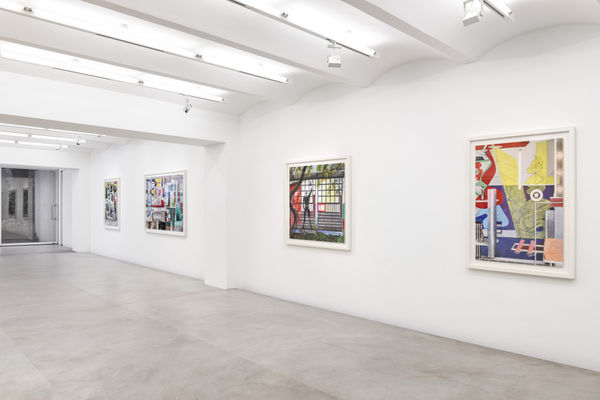
With the exhibition E-1027+123, French photographer Stéphane Couturier turns his attention to the iconic architectural masterpiece of Eileen Gray. With her villa E-1027, Gray created not merely a house but a manifesto of modernism from a female perspective. She deliberately set her designs against the dominant ideas of her era, showing that architecture can embrace intimacy, atmosphere, and quality of life as much as it can embody formal rigor.
Built between 1926 and 1929 in Roquebrune-Cap-Martin, E-1027 was Gray’s first major architectural project. Even its title carried a personal code: “E” for Eileen, “10” for J (Jean Badovici, her partner), “2” for B, and “7” for G (Gray). This cryptic monogram reveals that the villa was also, in essence, a declaration of love.
Gray conceived E-1027 as a total work of art, in which architecture, furniture, lighting, and textiles were finely attuned to one another. In contrast to Le Corbusier’s idea of the “machine for living,” she imagined the house as a protective shell—a space that offered both openness and security.
Yet the story of the villa soon took a dramatic turn. After Gray moved out, Le Corbusier—Badovici’s close friend—frequently stayed there, and between 1937 and 1939 he painted several large-scale murals directly onto its walls. What he regarded as an artistic gesture, Gray experienced as a violation, a disfigurement of her creation so profound that she never returned to E-1027.
It is precisely this tension that Stéphane Couturier explores and reimagines in his own visual language. Through the technique of double exposure, merging analog and digital processes, he overlays Gray’s austere geometry with Le Corbusier’s expressive interventions. The resulting images vibrate with layered complexity, where reality and abstraction, architecture and intrusion, past and present flow into one another. The effect is a form of hyperrealism, capturing not only the atmosphere of the site but also its social, political, and artistic dimensions.
The exhibition also resonates with Couturier’s earlier projects. Whether photographing the industrial structures of Valenciennes, Le Corbusier’s utopian city Chandigarh in India, or the monumental housing project Climat de France in Algiers, he consistently approaches architecture as a mirror of societal change and transformation. His works reveal how buildings are shaped by life, reinterpretation, and transformation, becoming resonant spaces of human experience.
With E-1027+123, Couturier continues this inquiry. His complex visual worlds layer history with the present, telling stories not just of form, but of utopia, memory, and the transformation of architecture into both a political and poetic medium.
Stéphane Couturier (*1957, France) is recognized as one of the leading figures in contemporary photography. Since the 1990s, he has investigated urban landscapes and architectural projects worldwide. His works are included in prestigious collections such as the Centre Pompidou, the Bibliothèque Nationale de France, the National Gallery of Art in Washington, and the Los Angeles County Museum of Art (LACMA).
Couturier’s works have been the subject of numerous international solo exhibitions. In 2025, under the title E-1027+123 Eileen Gray / Le Corbusier, his works were presented at the Abbaye de Montmajour as part of the Rencontres de la Photographie in Arles and are now on view at Kornfeld Galerie Berlin. In 2023, the Jeu de Paume Le Cellier in Reims dedicated the exhibition Construire par l’Image to him. His works also attracted major attention in China: in 2021, they were shown at the Fusheng Museum in Wuhan and at the Jupiter Museum in Shenzhen, where the series Melting Pointwas presented. Further highlights include Entrelacements at the Repaire Urbain, Artothèque in Angers and Transmutations at the Arendt House in Luxembourg (2020), as well as the comprehensive 2019 survey of his work at the Musée National Fernand Léger in Biot, France.
