Kota Ezawa – Opus III

OPUS is an exhibition project by German/Japanese/American artist Kota Ezawa with stops in New York, Frankfurt, and Berlin. His works in OPUS III, installations, video projections, watercolours, light boxes, and wall-mounted spatial installations reflect, on isolation and participation, loneliness and separation, as well as on war and peace and their direct and indirect effects on people, buildings, and spaces.



68projects is pleased to present OPUS III by German/Japanese/American artist Kota Ezawa.
OPUS is an exhibition project with previous stops in New York, Frankfurt, and Berlin. In OPUS III, Ezawa presents installations, video projections, watercolours, light boxes, and wall-mounted spatial installations that reflect on isolation and participation, loneliness and separation, as well as on war and peace and their direct and indirect effects on people, buildings, and spaces.
Kota Ezawa is known for translating and reinterpreting documentary footage—news, film clips, works by other artists, and images stored in our collective memory—into watercolour animations. Events of historical significance stand on equal footing with moments of pop culture. Transposed into two-dimensional, literally flat images, Ezawa’s works condense complex visual information into their basic elements. Described by the artist as “animated paintings,” they combine a handcrafted aesthetic with a visual language borrowed from comics and pop art.
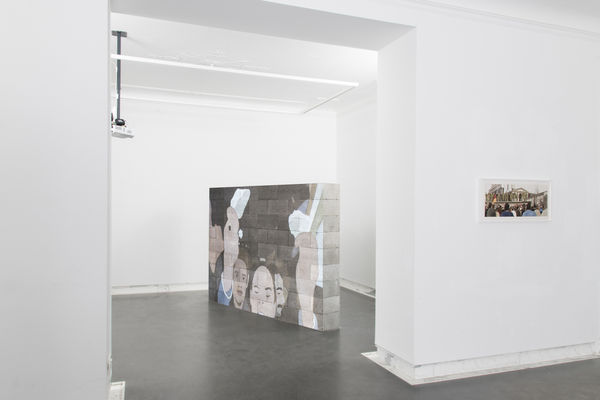
THERISEANDFALLOFTHEBERLINWALL is a video projection on a wall made of concrete blocks, spanning an arc from the construction of the Berlin Wall in the summer of 1961 to its fall in the autumn of 1989. The installation is accompanied by four watercolours depicting people celebrating on top of the wall in November 1989.
For the projection, Ezawa draws on images from old newsreels and television broadcasts, translating them into watercolours that are then animated and woven into a compressed narrative with the help of a soundtrack. Black-and-white images of the wall’s construction in 1961 are accompanied by Joseph Haydn’s Opus 76 No. 3, Germany’s national anthem. The solemn melody is juxtaposed with images of barbed wire, military patrols, and East Berliners attempting to flee to the West.
The fall of the Berlin Wall 28 years later is shown in colourful images, accompanied by a sample from Pink Floyd’s Another Brick in the Wall, Pt. 1, as well as triumphant cheering, chanting, and the clinking of chisels dismantling the wall that had seemed insurmountable until that moment. Peacefully won freedom triumphs over state violence and oppression.
Using a wide landscape panorama, the light box Border Wall Prototypes presents various prototypes for Donald Trump’s border wall separating the United States from its southern neighbour Mexico. The visual parallels with the Berlin Wall are undeniable. In May 2021, Trump’s successor Joe Biden put the project on hold, which is why the prototype walls in Ezawa’s work remain unfinished and fragmentary—erected only for illustrative purposes.
In contrast, Kabul focuses closely on the wall surrounding Kabul airport, which appears almost insurmountable. Several people—including a child—attempt to climb the wall. It remains unclear whether their escape from the Taliban-ruled country will succeed. As we now know, since the Taliban returned to power in August 2021, reaching Kabul airport no longer guaranteed salvation.
Ezawa’s expansive installation Merzbau, combining wallpaper with several light boxes, can be read as an examination of the virtual walls erected since the outbreak of the Coronavirus pandemic: the avoidance of personal encounters, mistrust of strangers, and retreat into private space. The imagery and title reference Kurt Schwitters’ Merzbau, begun in 1923 and destroyed during Allied air raids in 1943. Schwitters’ work survives only through photographs and reconstructions. Likewise, the “ghost” of Merzbau resurrected in Ezawa’s installation ultimately remains two-dimensional.
Taken together, Ezawa explains, the works in OPUS “tell a story of building, construction, loss, and destruction. While focusing on events that took place in one country over the span of 66 years, these depictions serve as universal symbols of the past, present, and future of border walls and avant-garde art.”
Kota Ezawa (born 1969 in Cologne) studied at the Kunstakademie Düsseldorf and the San Francisco Art Institute before receiving his MFA from Stanford University. His works have been shown in numerous international exhibitions, including at the Georgia Museum of Art (Athens), Museo Thyssen-Bornemisza (Madrid), Chrysler Museum of Art (Norfolk), Metropolitan Museum of Art (New York), and St. Louis Art Museum. His works are held in major collections such as MoMA, the Metropolitan Museum of Art, the Whitney Museum of American Art, the Art Institute of Chicago, the Hirshhorn Museum and Sculpture Garden, the J. Paul Getty Museum, the Musée d’art contemporain de Montréal, the National Gallery of Victoria (Australia), and the Netherlands Institute for Media Art.
